
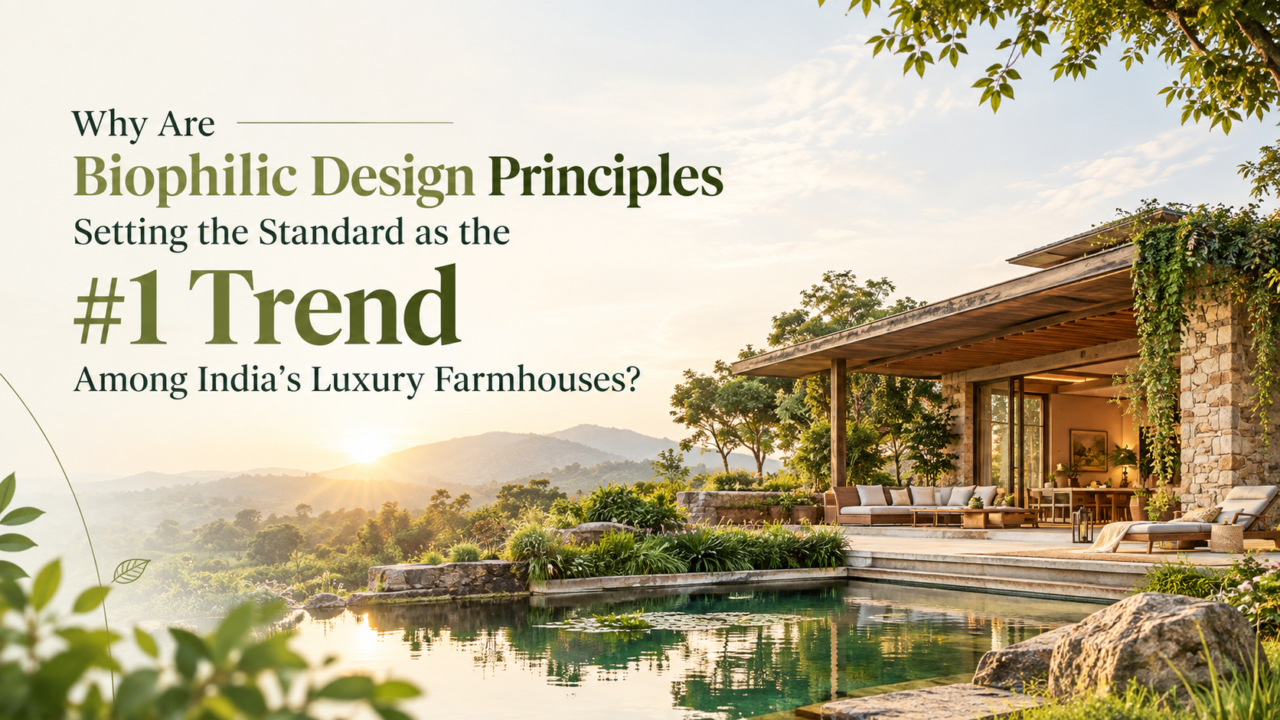
Today, every well-planned farmhouse will offer you something different from the marble-and-glass estates of just a few years back. Sunlight shines through the open courtyards, water bodies regulate temperatures naturally, and natural trees border every window opening rather than obstructing the view.
Lately, biophilic design farmhouse projects in India are leading the luxury real estate conversation, and for good reason.
As HNI & UHNWI buyers steer clear of concrete-heavy weekend homes and opt for an actual escape from the hustle and bustle of the urban jungle, the concept of a managed premium farmhouse is changing its very definition. And the philosophy behind it revolves around the sole principle that people tend to be better off amid nature than away from it.
What is Biophilic Design Anyway?
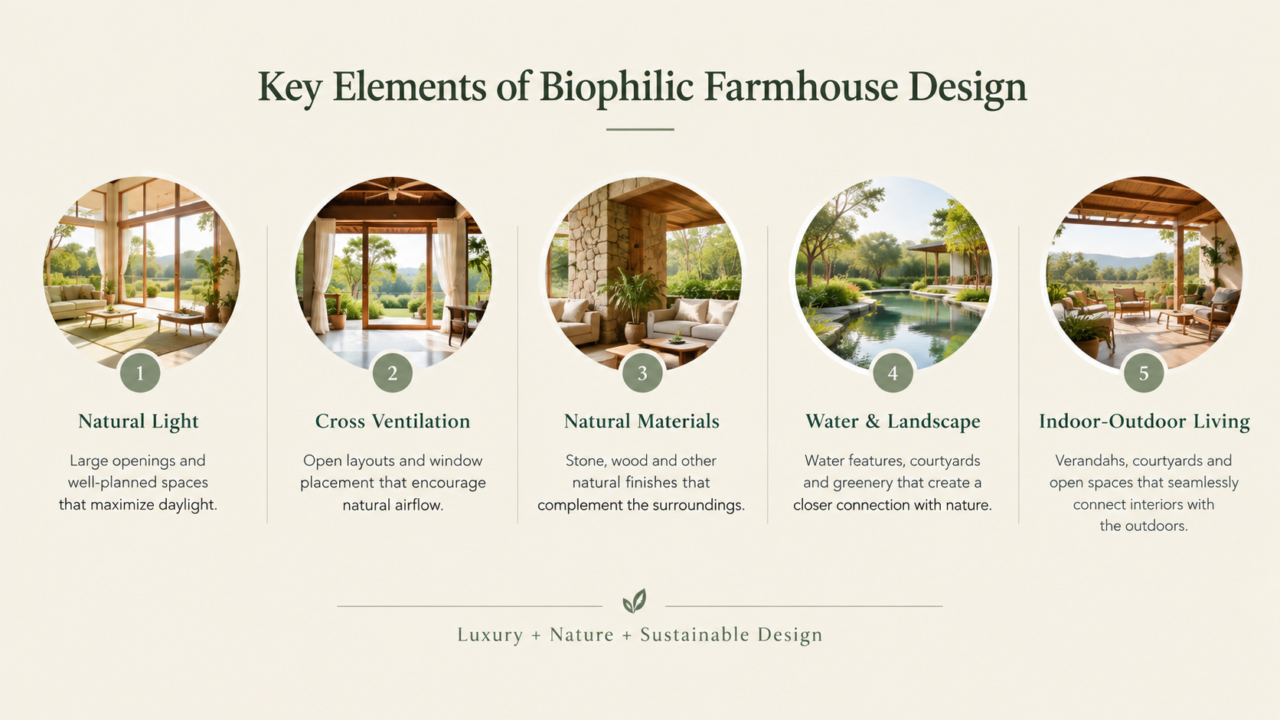
The concept behind biophilic architecture in India lies in the idea that living spaces need to reinforce, not disconnect us from nature. It is much more than the addition of a few potted plants on balconies. True biophilic architecture in India includes natural light and ventilation, incorporation of water, natural materials such as stone and wood, and a design that integrates indoors with outdoors.
For luxury farmhouses, this means courtyard space, which acts as a living area, verandahs, and gardens, which offer much more than beauty. They provide shelter from the sun, cool microclimates, and support biodiversity.
Why Is This Trend Exploding in India’s Farmhouse Market?
Post-COVID Wellness Trends
Over the last few years, the definition of home has gone beyond bricks. Fresh air, lots of light, and open space have now become non-negotiable for high-net-worth Indians. Investing in a biophilic design farmhouse in Delhi NCR is now correlated with one’s well-being because good sleep, stress reduction, and improved air quality are now selling points as valuable as square feet.
Real Retreat from Urban Life
Undoubtedly, the concept of a farmhouse involves an escape from the chaos of the city. But the traditional approach was just a mere attempt to copy the architecture of cities and create farmhouses with manicured gardens, marble, and large structures. Today’s HNI buyers seek precisely the opposite. The biophilic design farmhouse in India is constructed using local stone, landscaping, and natural cooling systems that blend in well with the surrounding environment.
Sustainability Becomes a Must
In today’s time, water harvesting systems, use of solar energy, natural ventilation, and planting of local trees have stopped being eco-friendly features and have become mandatory for a home. High-net-worth individuals are well aware that homes made up of glass and concrete require much energy. Farmhouses such as Rajvanam are built on the principle of nature-inspired home design, where every space is built to make people feel closer to nature without compromising on luxury.
Higher Property Value for the Long Term
Managed farmhouse ecosystems built on biophilic designs age better structurally and aesthetically. The natural materials used in their construction weather gracefully, and the landscape will only get more beautiful with time. Also, less use of artificial temperature control means fewer maintenance costs and makes the biophilic luxury farmhouse in Delhi NCR a much smarter investment.
Emotions and Mindset
Multiple studies have stated that exposure to natural environments reduces stress and anxiety and improves our concentration. This is the reason why a biophilic luxury farmhouse is not just about beauty; it is also about elevating one’s lifestyle. Starting the day with birds singing, walking around barefoot over stone, and having dinner in a vine-covered pergola is what no marble entrance could give you.
Where Is This Trend Being Implemented in India?
It is no wonder that the Aravalli belt in Rajasthan is emerging as a sought-after hotspot for luxury farmhouse developments inspired by biophilia. With its stunning views, cooler microclimate, and closeness to the Delhi-NCR region, the Aravalli belt makes a perfect location for weekend and retirement homes.
For HNI buyers looking for a luxurious second home, a farmhouse in Alwar provides them with the perfect blend of accessibility and pure nature that can be reached within a convenient driving distance of just 90 minutes from the capital. Biophilic luxury farmhouses like Rajvanam take their cue from the principles of cross-ventilated courtyard designs, use of native Aravalli stone in exteriors, and landscaping using indigenous and drought-resistant vegetation instead of thirsty lawns.
In a broader sense, when potential buyers look for the Best Farmhouse in Rajasthan, they are not merely comparing the size of plots and facilities anymore, but the way a development integrates into its surrounding environment.
Must read: What are the top 5 lifestyle benefits of owning a farmhouse?
What to Expect from the Biophilic Farmhouse Project
Here’s what to expect from this investment property:
- Orientation and ventilation – Houses constructed in a way that allows cross-ventilation and light, minimizing air conditioning use.
- Indigenous landscaping – Indigenous trees and vegetation that attract local fauna and need minimal water use.
- Natural materials – Stone, wood, and clay used over artificial products.
- Water presence – Ponds, rivers, or even systems for water collection that help maintain local ecosystems.
- Blurring of indoor and outdoor space – Verandas, courtyards, and other large openings that create unity between nature and construction.
Final Thoughts
The emergence of biophilic design farmhouse projects in India is not just an aesthetic phenomenon; it marks a new way of thinking about luxury. It is no longer about how much space you can create inside the four walls but how well it helps you engage with the natural environment surrounding you. With more and more builders embracing this concept in Delhi NCR, Rajasthan, and other places, biophilic design farmhouse projects will definitely make their mark in the next ten years.
If you’re interested in a farmhouse project that incorporates such biophilic design ideas in Rajasthan, Rajvanam, we have got you covered.
FAQs
What makes a farmhouse different from being biophilic?
A farmhouse that is considered biophilic would be one constructed using natural lighting, natural ventilation, indigenous plantation, and natural materials such as stone and wood, ensuring that the farmhouse is always linked to its environment and not separated from it.
Why are people adopting the concept of biophilic design for farmhouse development?
It is expected that farmhouses should offer a break from the city and hence have their own unique feeling compared to any other building. And the biophilic design elements make it easy for you to achieve this.
Will a biophilic farmhouse be more expensive in construction or maintenance?
No, not always. While some natural materials may cost more initially, a biophilic home will save money overall due to reduced energy costs (less need for air conditioning), less water use due to native plants, and materials that age gracefully with little maintenance.
What makes Alwar become a preferred location for biophilic farmhouses?
Alwar, located in the Aravalli mountain range, is ideal for vacation and retirement locations due to its relatively cooler climate, scenic environment, and proximity to Delhi NCR. Within Alwar, the Govindgarh region is fast becoming popular as a destination for the development of farmhouses owing to its distance from heavy industry and mining operations and also surrounded by extensive, green agricultural lands. The surroundings make for an environment that is conducive to biophilic living.