
| Quick Answer: The top five things to consider before investing in a farmhouse near Delhi are actual drive time to the area, verified air quality and greenery in the locality, clear and undisputed legal documents, lifestyle amenities, and long-term growth potential. Areas that have good connectivity via expressways, low pollution levels, and low density, such as Govindgarh in Alwar on the Delhi-Mumbai Expressway, tend to score high in all five aspects. |
A farmhouse is more than just a piece of land. It is a place where you come for relaxation, slowing down, and enjoying family time far from the hustle and bustle of urban areas. However, here is the reality that most potential buyers eventually come to terms with – ‘THE LOCATION OF THE FARMHOUSE MATTERS MOST.’
You can build the most beautiful home in the world, but if the location is wrong, you will end up dealing with bad roads, polluted air, water shortages, or a property that simply doesn’t hold its value. Hence, choosing the right location for your farmhouse in Rajasthan is the most important decision to make in the whole process.
At Rajvanam, we have spent years evaluating sites across the Delhi NCR and Jaipur belt before settling on Govindgarh. Here’s what we looked for as landowners ourselves, and what we would want you to look for as well.
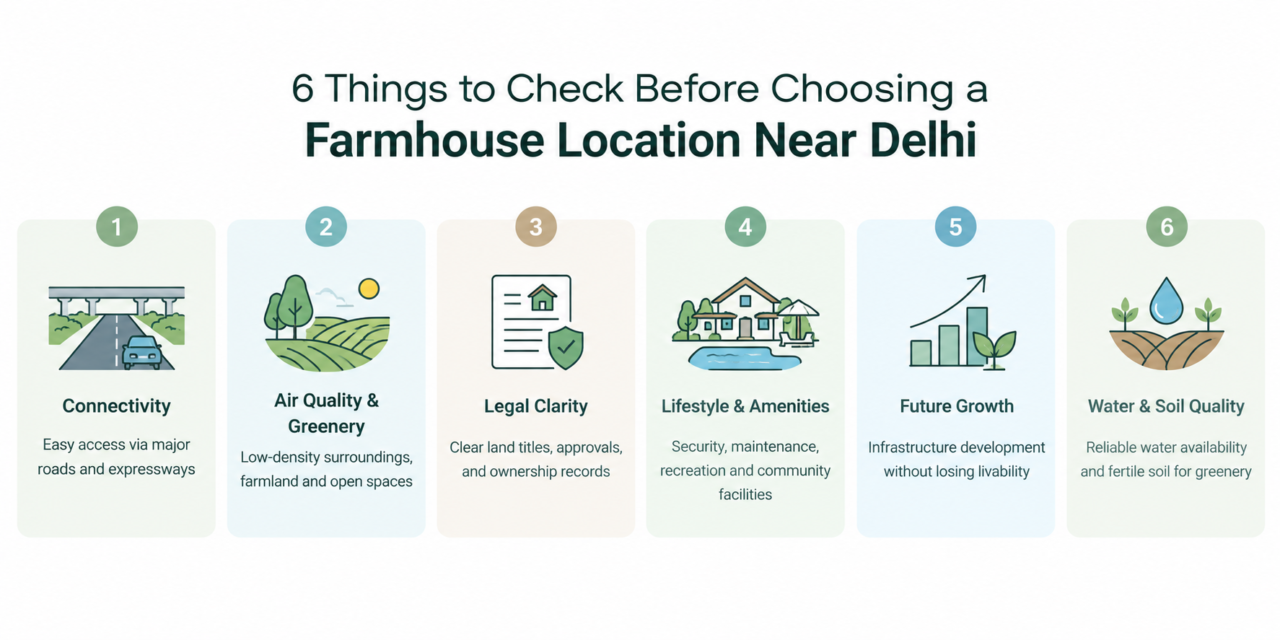
Connectivity Should Make Weekends Easier, Not A Logistical Exercise
This was the first criterion we checked while evaluating the land for Rajvanam. A farmhouse that’s 30 minutes away on paper can easily become a 4-hour drive on a Friday evening, once you add traffic, toll queues, and bad stretches of road.
The right location offers direct, dependable access from Delhi-NCR and Jaipur while still feeling removed from the city. This is why expressway-linked destinations have become more attractive as they reduce travel friction without forcing buyers to compromise on space and privacy.
Govindgarh’s position along the Delhi-Mumbai Expressway is important for this reason. It gives families a practical route from Gurgaon and Jaipur while preserving the sense of arriving somewhere distinctly quieter and greener.
The real measure of connectivity is simple: can your family leave after a busy week and still arrive in time to enjoy the evening?
| Expert Tip: In our experience acquiring land in locations near an expressway corridor, especially one connecting two major cities, we see the sharpest jump in convenience and property value once new interchanges or exits open up. Buying just before this happens is when early investors gain the most. |
A Farmhouse Must Deliver the Air Quality and Environment It Promises
Let’s be honest, most people don’t buy a farmhouse for the square footage. They buy it to escape the pollution and concrete of the city. So if the location you’re considering doesn’t actually offer cleaner air, you’re paying a premium for something you won’t get.
Agricultural land, tree cover, water bodies, and low-density development can help preserve a retreat-like environment. By contrast, locations like Naugaon, where the future is shaped primarily by dense construction, heavy freight movement, or industrial expansion, may serve a different buyer altogether.
This is an important distinction when comparing emerging farmhouse destinations. Some locations are marketed primarily for industrial-led land appreciation. That may suit a pure land investor, but a family buying a second home should also consider what that development could mean for future traffic, noise, dust, and the overall character of the area.
Govindgarh offers a more nature-led proposition: expressway access, open agricultural surroundings, and a lower-density setting that supports the farmhouse lifestyle buyers are seeking in the first place.
| Did You Know? Areas surrounded by active farmland typically record lower AQI than urban outskirts, because farmland absorbs dust and doesn’t generate the vehicle and construction pollution that comes with dense development. Government AQI bulletins bear this out for the Alwar belt specifically. |
Land Titles, Approvals, and Legal Clarity Are The Foundation of Ownership
This is the least glamorous part of a farmhouse location checklist, and in our view, also the most important. A stunning location means nothing if the land has disputed ownership, unclear titles, or missing approvals. We’ve seen buyers lose money not because they chose a bad location, but because they skipped this step entirely.
Before buying, buyers should understand whether the project has clear title documentation, appropriate approvals, and a defined plan for roads, electricity, water, and maintenance. These are not administrative details to review after falling in love with a site; they determine whether the property can be enjoyed confidently and transferred smoothly in the future.
For managed farmhouse estates, legal and operational clarity matters even more. The buyer is not only acquiring land, but also relying on the project’s ability to maintain shared infrastructure, security, landscaping, and community amenities over time.
A Farmhouse Location Must Support a Real Lifestyle
A farmhouse location isn’t just about the land plot; it’s about what your life looks like once you’re there. We always ask buyers: if you spend a full weekend here, what would it look like? Would you like a place to walk, eat, exercise, host friends, let children play, or simply spend time outdoors? What do you think of a fully managed gated farmhouse community where the farmhouse is secure and maintained when the family is away?
Independent plots can offer flexibility, but they also place the burden of security, gardening, repairs, staff, and maintenance entirely on the owner. A professionally managed estate makes ownership easier by creating the services and shared experiences that encourage families to return more often.
At Rajvanam, we have planned the estate as more than just a collection of farmhouses. Green spaces, orchards, water bodies, trails, a clubhouse, dining, fitness, and family recreation make the location usable across generations, not just attractive during a site visit.
| Did You Know? Independent farmhouse plots without any managed ecosystem often stay underused for years, because owners get tired of coordinating security, gardening, repairs, and staff on their own. This is one of the clearest patterns we have seen in this market, and it’s exactly why a managed farmhouse ecosystem has become the preferred choice for busy, high-performing families who want ownership without the daily hassle. |
Future Development Should Add Value Without Taking Away Livability
A farmhouse is also a financial decision, even if it doesn’t feel like one at the time of buying. Location decides whether your land appreciates steadily or just sits there.
The strongest locations benefit from better roads, regional connectivity, tourism, and thoughtful development, without losing their calm, green character. In other words, growth should make the destination easier to reach and more valuable, not make it feel like an extension of the city.
Rajvanam, being located in Govindgarh, benefits from the wider Delhi-Mumbai corridor and improving access across Rajasthan. Yet it remains outside the more intensive industrial-development belt associated with the Khushkhera-Bhiwadi-Neemrana region.
For a farmhouse buyer, this creates a more balanced proposition: the infrastructure upside of a growing corridor, alongside the open landscapes and lower-density environment that make a second home worth owning.
| Expert Tip: According to industry data reported by Financial Express, India’s farmhouse and plotted-luxury segment is now valued at around $3.2 billion and growing at 22-23% CAGR, translating to roughly 16,700 units a year. In our experience, locations along established expressway corridors, with genuine connectivity and low-density planning, are consistently the ones capturing this demand, not isolated plots with no supporting ecosystem around them. |
Water Availability and Soil Fertility Determine How Well the Land Can Live
This is one of the most overlooked aspects of farmhouse buying, yet it shapes the everyday reality of the property. Water affects everything, such as landscaping, private gardens, orchards, kitchen gardens, pools, maintenance, and the long-term ability to keep the estate green. Similarly, soil quality matters just as much. Fertile land gives a farmhouse a living landscape that can support plantations, fruit trees, organic gardens, and a stronger connection to nature.
In and around Govindgarh, local groundwater observations place the water level at approximately 50 feet in many areas, alongside fertile agricultural soil that is favourable for greenery and cultivation. In comparison, buyers assessing other belts such as Naugaon should examine plot-specific groundwater depth, water yield, and soil condition closely; local observations in some areas indicate substantially deeper water levels, often beyond 100 feet.
The principle remains clear: a farmhouse should not depend entirely on imported greenery and artificial landscaping. The land itself should be capable of sustaining the life you imagine there.
Why Govindgarh, Alwar, Is Becoming the Belt to Watch
When we applied these five factors to real locations around Delhi NCR, very few belts hit all of them at once. Govindgarh, in Alwar district, on the Rajasthan side of the Aravalli range, is one of the few that does. Here’s what convinced us, in numbers, not just scenery.
1. Connectivity backed by hard infrastructure, not intent.
Govindgarh falls directly on the Delhi-Mumbai Expressway, which is India’s longest expressway spanning a distance of about 1,350 km and constructed as a greenfield project in an 8-lane format with a maximum speed limit of 120 km per hour. It is already bringing the travel time between Delhi and Jaipur via the Sohna-Dausa stretch of the Delhi-Mumbai Expressway to under two hours, and NHAI has confirmed that the expressway is now more than 80% completed with full commissioning coming up. This is not about a proposed road.
2. Air quality that shows up in the data, not just the brochure.
Real-time bulletins from the Commission for Air Quality Management (CAQM) consistently place Alwar in the “Satisfactory” AQI band, even on days when Delhi and Gurugram swing into “Moderate” or “Poor.” In a number of recent reports, Alwar’s AQI has found itself 40-100+ points lower than Delhi’s. The fact that the city is situated in the Aravalli hills, amidst green agricultural fields, is not just about its picturesque beauty; it is a tangible factor of good air quality.
3. A belt that isn’t crowded yet.
Unlike farmhouse pockets closer to Gurgaon or Faridabad that have already been carved up over the last decade, Govindgarh is still an early-stage micro-market. That means land here carries genuine room for appreciation as the expressway corridor fully matures, rather than an inflated price tag for a belt that’s already peaked. This is a big part of why we chose to acquire and build here rather than in an already-saturated pocket.
4. Heritage and nature as a built-in bonus, not a marketing add-on.
This is the part that surprises most first-time visitors to our site, and honestly, it’s part of what sold us on this land in the first place. Within a short drive of Govindgarh sits Bharatpur Bird Sanctuary, Sariska Tiger Reserve, Pink City Jaipur, Ranthambore National Park, Tak Mahal in Agra, Mathura, and Vrindavan.
About Rajvanam
Rajvanam is our 27-acre farmhouse estate in Govindgarh, Alwar, built around the five factors covered in this article. Phase I consists of 31 luxury farmhouses ranging from 1,800 to 3,025 sq. yards, each with 2 to 5 bedrooms, a private garden, and a personal kitchen garden of 150 to 350 sq. yards.
More than 50% of the estate is covered by greenery, having over 10,000+ trees, plants, orchards, water bodies, and nature trails. The clubhouse covers 25,000+ sq. ft. area and consists of a round-the-clock restaurant and café, swimming pool, gym, yoga zone, event areas, mini-theatre, and business center.
Each farmhouse comes with clear titles, approvals, CCTV and gate security round the clock, and centralized maintenance management, which means the property will be easy to own from the very beginning.
Even the best farmhouse locations near Delhi provide either good connectivity or nature but rarely both of them; even less do they offer culture and heritage as an extra element to that equation. In Govindgarh, because it is located along the Delhi-Mumbai Expressway, you will enjoy a very unique offering of a serene and sparsely populated home base along with world-class destinations just within driving distance from the same.
This is precisely why Rajvanam was planned in Govindgarh and not in one of the more crowded, oversaturated farmhouse belts closer to the city. The location itself does a lot of the work that amenities and design usually have to compensate for elsewhere.
In Conclusion: Let the Location Do the Heavy Lifting
Choosing a farmhouse is easy to get excited about: the interiors, the garden, the pool. But none of that will matter if the location underneath it is wrong. Poor connectivity, uncertain air quality, unclear titles, no real community, and a belt with no growth story; any one of these can turn a dream purchase into a long-term disappointment.
And the best part is that no need for real estate expertise is required to get this right. All you require is deliberation; drive there yourself, seek the paperwork, spend a day there enjoying the environment, and reflect on what your life would be like in a few years down the line, not only at the time of signing the paperwork.
Locations such as Govindgarh, Alwar have shown how connectivity, clean air, clear legal aspects, lifestyle, and long-term values all converge into a single belt, supplemented even further by some heritage and natural experience just at its doorsteps. This is the type of location that can not just hold your farmhouse well but also your family memories for decades to come.
Frequently Asked Questions
What should be the ideal distance from Delhi and Gurgaon for a farmhouse?
Most buyers prefer a farmhouse within a 60–90 minute drive from their city. This is close enough for weekend trips, yet far enough to offer genuinely open, low-density surroundings with cleaner air.
Why are people choosing to buy farmhouses in Alwar?
Alwar lies on the Delhi-Mumbai Expressway and is surrounded by the Aravalli hills and farms, which means that the level of pollution is relatively low. Moreover, the area is close to other tourist destinations such as Ranthambore, Bharatpur, Agra, Mathura, Vrindavan, and Jaipur.
Is the managed community concept of a farmhouse better than buying a piece of land independently?
Yes, it is. In the case of a managed community, the buyer is guaranteed not only security and maintenance but also the maintenance of his/her property while he/she does not visit it.
How do I verify if a farmhouse land has clear legal titles?
Ask the developer directly for title documents, ownership history, and local approval certificates before booking. A credible project will share these without resistance.
Looking to explore a managed luxury farmhouse near the Aravalli hills, off the Delhi–Mumbai Expressway? Schedule a private site visit at Rajvanam and experience the location firsthand.