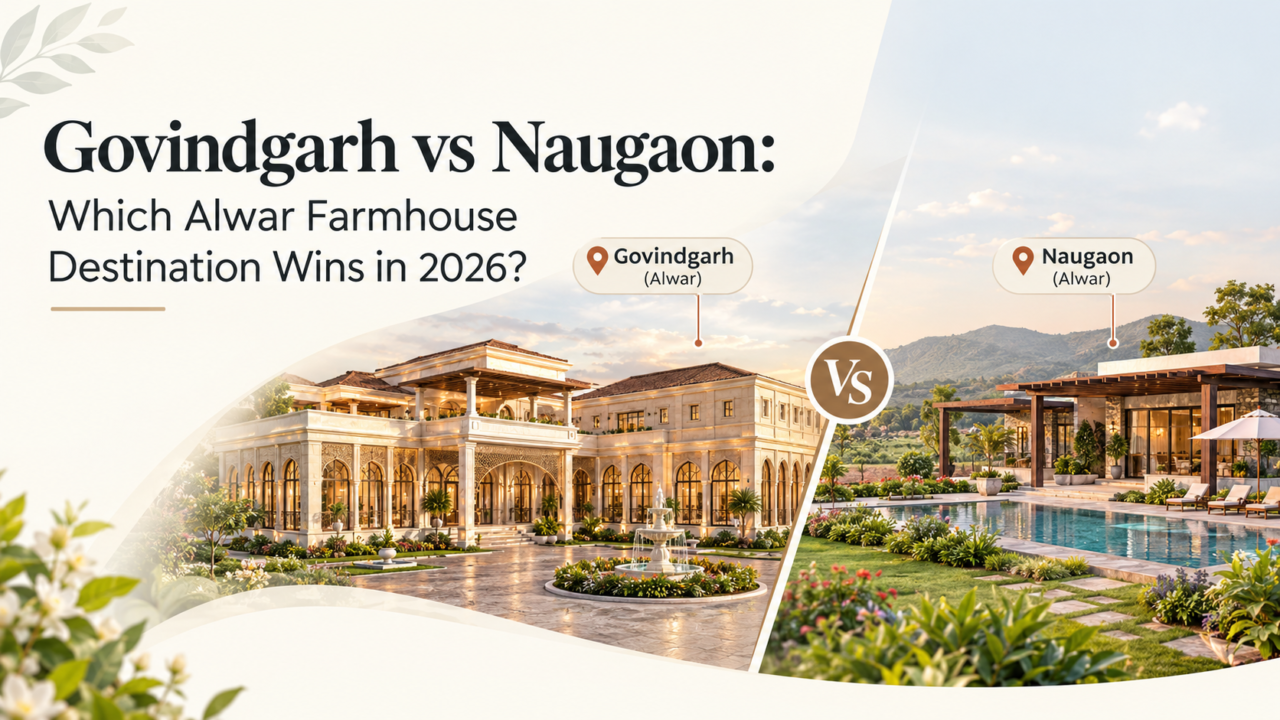
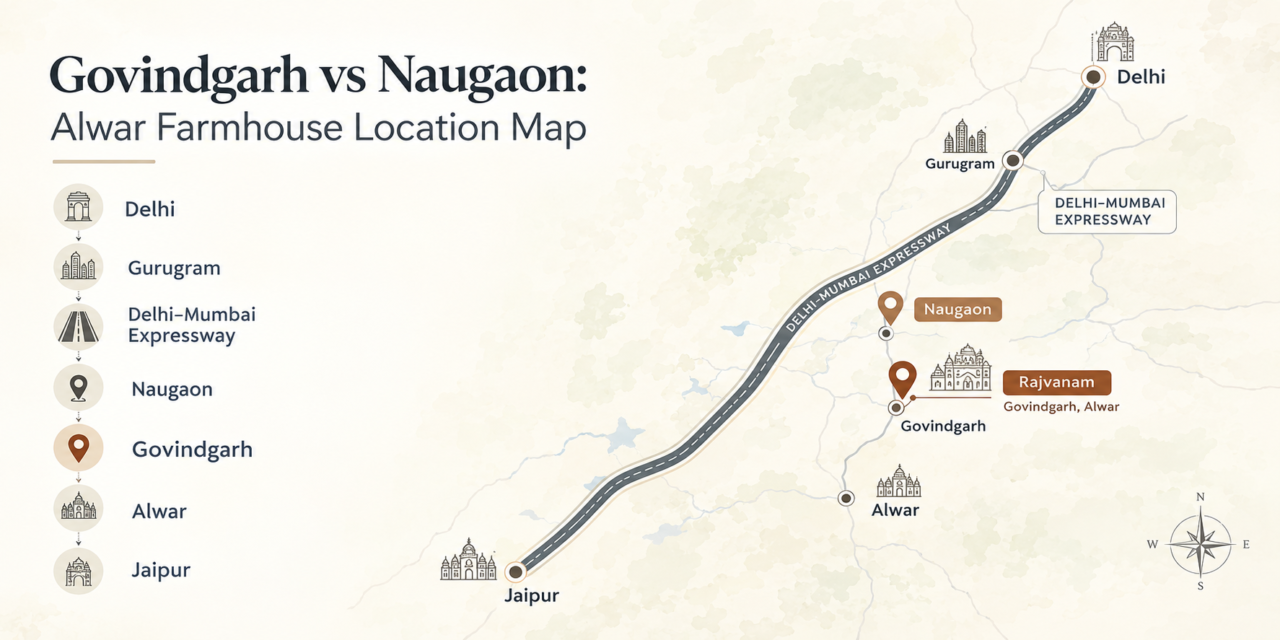
The Delhi-Mumbai Corridor is becoming a favoured investment spot for farmhouses, with many luxury farmhouse zones luring buyers in search of second homes and weekend getaways. Of these, the Naugaon and Govindgarh zones of Alwar have been drawing special attention due to their proximity to the NCR region. Naugaon is the more mature and better-known belt, whereas Govindgarh is home to the newer, luxurious managed farmhouse community. Both sit on the Delhi–Mumbai Expressway, roughly 90 minutes from Gurgaon, so on paper the choice looks like a toss-up.
However, once you look past connectivity, It isn’t. Naugaon’s own developer listings confirm that RIICO is building a new industrial hub in the area, and Naugaon also falls inside a tehsil with a documented history of illegal Aravalli mining. Govindgarh has neither problem. It’s positioned instead along Alwar’s tourism and heritage circuit, near Siliserh Lake, Sariska Tiger Reserve, and Bharatpur Bird Sanctuary.
This guide walks through the Govindgarh vs Naugaon comparison in detail: connectivity, industrial exposure, mining history, and the investment data behind each, so you can see exactly why Govindgarh is emerging as Alwar’s more future-proof farmhouse destination for 2026.
Alwar’s Farmhouse Boom, By the Numbers
The Delhi–Mumbai Expressway (DME) has turned Alwar district into one of North India’s fastest-appreciating farmhouse and second-home corridors, which is exactly why the Govindgarh vs Naugaon question matters more now than it did even two years ago.
- The Delhi–Mumbai Expressway, valued at US$ 13.1 billion, runs roughly 400 km through Rajasthan alone, giving the state the single largest share out of the total 1,380 km corridor.
- Towns along this stretch of the expressway, including Alwar, have recorded 35-45% property price growth over a four-year period, driven directly by industrial expansion and improved connectivity.
- Delhi-NCR luxury housing prices climbed roughly 72% as of last year, pushing affluent buyers to look further out for land-based alternatives that luxury farmhouse developments in Alwar are now competing for.
- Alwar district already hosts a formal industrial base: the Alwar MIA (Matasya Industrial Area) and the Khushkhera-Bhiwadi-Neemrana (KBN) Investment Region, a designated DMIC industrial zone spanning 165 sq. km across 42 villages of the district. For Govindgarh and Naugaon, this creates a potential pool of business owners, senior professionals, and industrial employees seeking weekend homes and second-home properties within accessible distance.
| Think about it: Delhi-Mumbai Expressway drives both land-value appreciation and Alwar’s industrial ambitions. The question for a farmhouse buyer isn’t whether this growth is happening; it’s where inside Alwar you want to be standing when it does. |
The Other Side of Growth: What’s Actually Happening in the Naugaon Belt
Today, when you search “Naugaon farmhouse Alwar”, most listings highlight the same growth driver: RIICO (Rajasthan State Industrial Development and Investment Corporation) is actively building new industrial infrastructure in and around Naugaon, including a confirmed layout for an industrial hub at Moonpur Karmala village.
While this may be considered in favour of land appreciation, it is another issue when considering people who are looking to buy a farmhouse as their second residence. The industrial growth will affect the aspects of the property that make it an attractive property, such as cleaner air, reduced noise pollution, spacious areas, and relaxed living.
For those prioritising wellness and everyday liveability, a farmhouse in a low-AQI, low-noise zone may offer more enduring lifestyle value than one positioned primarily around industrial-led growth.
Naugaon sits within Malakhera tehsil, one of the areas explicitly known for Aravalli mining activities in Alwar district. Large-scale stone mining across this belt, including Naugaon, Tijara, Ramgarh, Kishangarh Bas, Laxmangarh, and Rajgarh, ran for decades, supplying stone crushers just across the Haryana border and leaving visible scars on the surrounding hills that remain today. The movement of heavy dumpers and mining vehicles also affects local roads, adding noise, dust, congestion, and safety concerns for residents and families travelling through the area.
The regional consequences of this kind of mining are well documented at the state level:
- The Supreme Court’s Central Empowered Committee found in 2018 that roughly 25% of Rajasthan’s Aravalli hill cover had already been lost to illegal mining and stone crushing.
- Dust from mining crushers and heavy transport vehicles has been shown to settle on crops, degrading soil quality and contaminating water and air across affected Aravalli belts, while falling groundwater levels threaten natural rainwater recharge.
- Rajasthan has identified around 25% to 40% of silicosis cases, a lung disease linked to mining and crushing dust, reflecting how significant the health footprint of unregulated stone mining has become across Aravalli districts, especially in Naugaon due to its close proximity to industrial areas.
| The honest picture: In the Naugaon vs Govindgarh comparison, Naugaon offers real land appreciation potential, but it comes bundled with an active industrial rollout sitting on top of a documented mining history a combination that raises legitimate questions about long-term noise, dust, traffic, and air quality for a property meant to be a peaceful weekend retreat. |
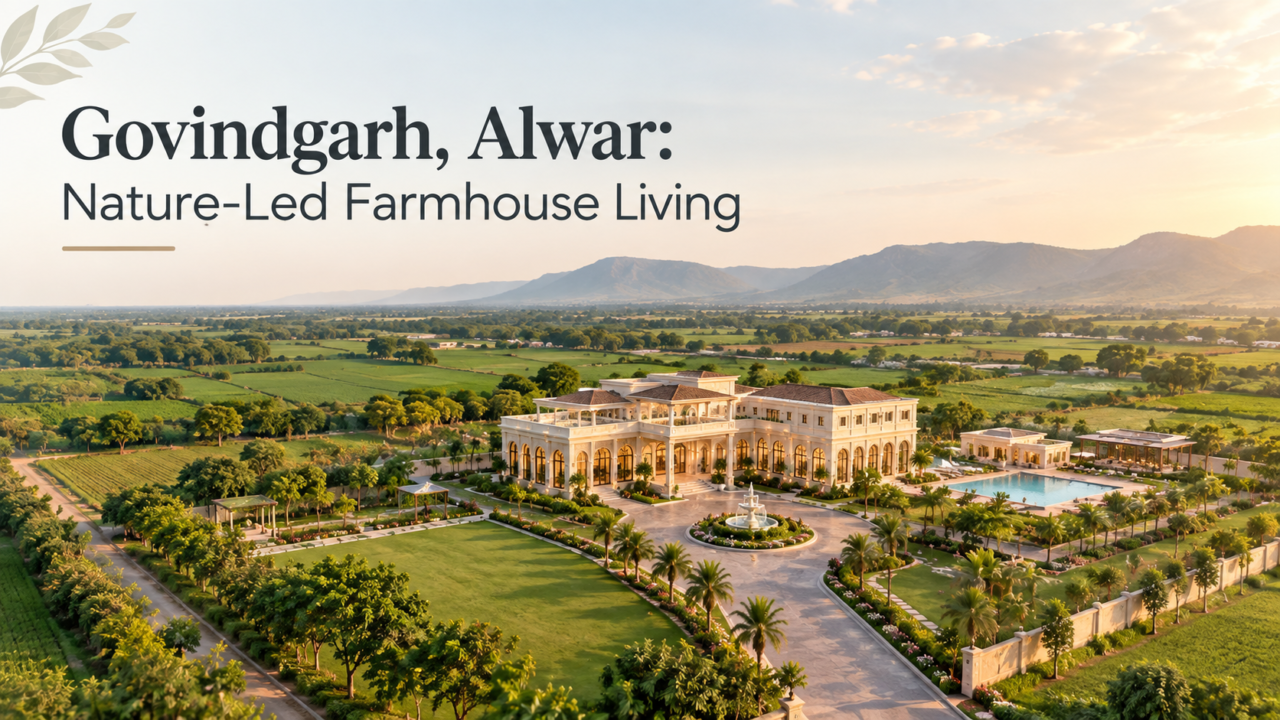
Govindgarh Farmhouse Alwar: Growth Without the Industrial Trade-Off
A luxurious farmhouse in Govindgarh sits on the same Delhi–Mumbai Expressway corridor, roughly 90 minutes from Gurgaon, but Govindgarh is not named among Alwar’s historically mining-affected tehsils, and it is not the site of RIICO’s newer Naugaon-area industrial layout.
Instead of an industrial hinterland, Govindgarh’s surroundings read like a tourism map with a vast span of serene green lands, and cultural and heritage destinations such as Bharatpur Bird Sanctuary, Ranthambore National Park, Agra, Mathura, and Vrindavan all a short drive away, making it perfect for a day trip.
This distinction is only going to matter more with time:
- Govindgarh, positioned along the expressway, offers the advantage of DMIC connectivity while remaining close to open green landscapes and a more nature-led setting. For farmhouse buyers, this translates into cleaner surroundings, lower noise levels, and the potential for better air quality without giving up convenient access to Delhi-NCR and Jaipur.
- Govindgarh’s flagship development, Rajvanam, is a 27-acre, 31-farmhouse managed community designed around exclusivity and holistic living. Unlike Naugaon’s multi-developer, open-plot model, Rajvanam offers a limited number of farmhouses, creating a more private, exclusive clubhouse and curated ownership experience.
- Because Govindgarh’s growth is tourism-lifestyle-anchored rather than industry-anchored, its trajectory looks closer to Rajasthan’s heritage-and-hospitality boom than to a manufacturing town’s.
Govindgarh vs Naugaon: The Side-by-Side Comparison
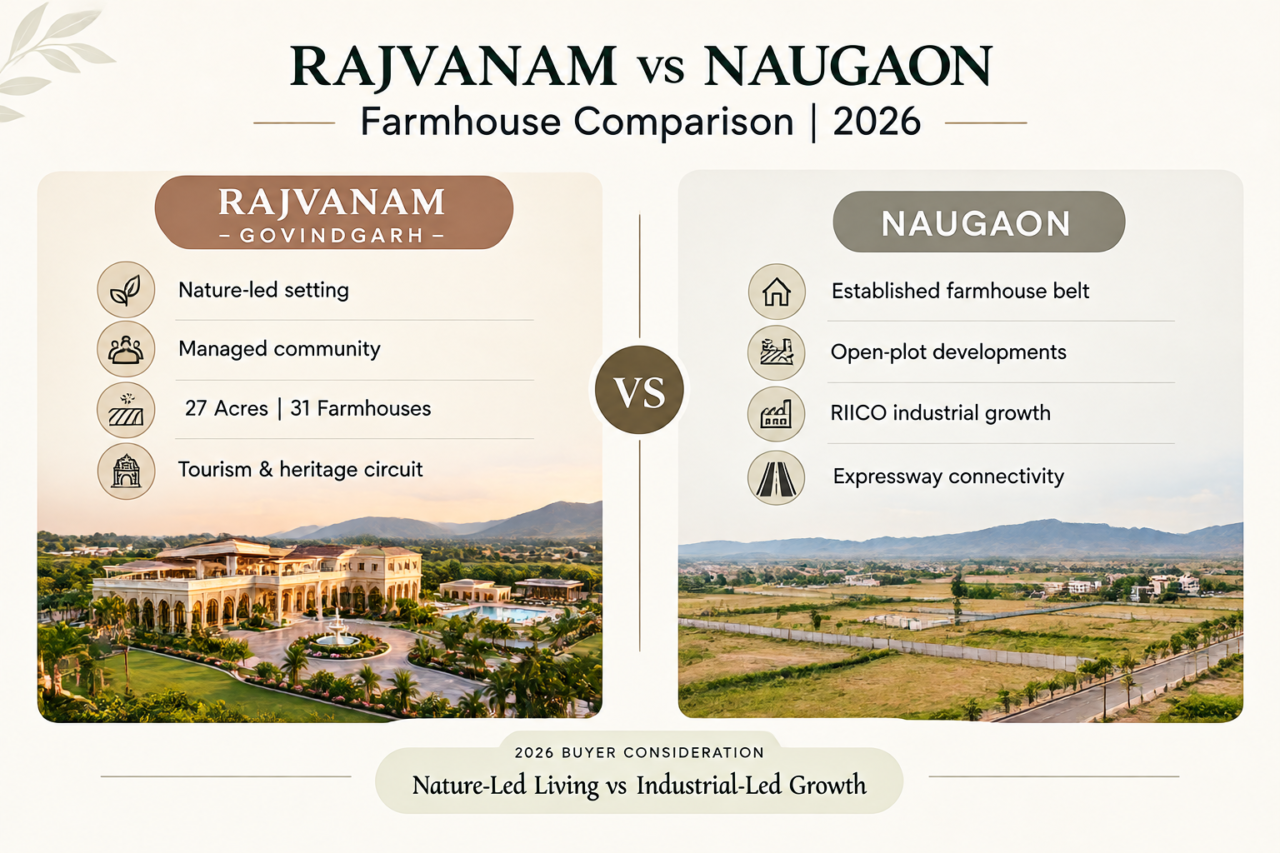
| Factor | Govindgarh (Rajvanam) | Naugaon |
| Distance from Gurgaon | ~90 minutes via DME | ~90 minutes via DME |
| Named in Aravalli extensive-mining reports | Not listed | Explicitly listed (Malakhera tehsil belt) |
| New Industrial Development (RIICO) | Not the site of RIICO’s Naugaon-area layout | Active RIICO industrial hub planned nearby (Moonpur Karmala) |
| Primary growth driver | Tourism, heritage circuit, managed luxury demand, and vast green fields. | Industrial expansion, factory employment |
| Nearby landmarks | Bharatpur Bird Sanctuary, Ranthambore National Park, Agra, Mathura, and Vrindavan | Siliserh Lake, Sariska Tiger Reserve, Tijara Fort, Alwar Fort |
| Development model | Single managed community (27 acres / 31 farmhouses) | Multiple independent developers, open plots |
| Future surroundings & livability | Nature-led setting with open green land, agricultural surroundings, and lower-density development. | Faster-changing surroundings with more industrialdevelopment activity in the wider area. |
| Groundwater availability | Groundwater is typically available at approximately 50 ft, supporting easier access for landscaping, kitchen gardens, and estate-level water needs. | Groundwater is typically found at depths of 100+ ft, which may increase dependence on deeper borewells and water-management systems. |
| Soil & landscape | Fertile agricultural soil and green surroundings support orchards, organic gardens, and nature-led farmhouse living. | Comparatively less suited to a nature-first farmhouse proposition. |
| Rail connectivity | Govindgarh Railway Station provides direct local rail connectivity. | No railway station in Naugaon; the closest rail access is at Ramgarh, approximately 12 km away. |
Rajvanam vs Naugaon: Which Wins for 2026 Buyers?
Every farmhouse buyer is really betting on what their surroundings will look and feel like a decade from now, not just today. Alwar’s expressway-driven appreciation isn’t in question; the 35-45% four-year price growth and the 72% NCR luxury housing surge both confirm capital is moving into this corridor regardless of tehsil.
The real decision is whether that capital lands next to a RIICO industrial layout in a documented mining belt, or next to a lake, a tiger reserve, and a bird sanctuary.
For buyers prioritizing pure land appreciation and comfortable with an industrializing neighborhood, a Naugaon farmhouse in Alwar remains an active, well-marketed option. For buyers who want the expressway’s connectivity and appreciation curve without inheriting an industrial and mining-adjacent backdrop, Govindgarh led by Rajvanam is emerging as Alwar’s stronger long-term managed farmhouse destination in 2026.
Frequently Asked Question
Is Govindgarh a good location for a farmhouse in Alwar?
Yes. Govindgarh sits directly off the Delhi–Mumbai Expressway, roughly 90 minutes from Gurgaon, and is positioned near Alwar’s tourism and heritage circuit, including Bharatpur Bird Sanctuary, Ranthambore National Park, Agra, Mathura, and Vrindavan rather than inside an industrial or historically mining-affected belt with a few options like Siliserh Lake, Sariska Tiger Reserve, and Tijara Fort.
Does Naugaon have industrial or mining activity nearby?
Naugaon falls within Malakhera tehsil, which has been named in reporting on illegal Aravalli mining in Alwar district. Separately, RIICO (Rajasthan State Industrial Development and Investment Corporation) has confirmed new industrial development plans in and around Naugaon, including a layout at Moonpur Karmala village.
How much Aravalli hill cover has been lost to mining in Rajasthan?
The Supreme Court’s Central Empowered Committee found in 2018 that approximately 25% of Rajasthan’s Aravalli hill cover had already been lost to illegal mining and stone crushing.
Is Govindgarh part of the Delhi-Mumbai Industrial Corridor (DMIC)?
Govindgarh sits along the Delhi–Mumbai Expressway, which is part of the broader DMIC connectivity backbone. This allows it to benefit from improved road infrastructure, faster access to Delhi-NCR and Jaipur, and the potential for long-term regional appreciation. At the same time, Govindgarh is outside the designated Khushkhera-Bhiwadi-Neemrana (KBN) industrial investment region. For farmhouse buyers, this offers a more balanced proposition: access to the corridor’s infrastructure advantages while retaining a greener, lower-density environment that supports better air quality and a quieter lifestyle.
Govindgarh vs Naugaon: which is the better farmhouse investment in Alwar?
Both sit on the Delhi–Mumbai Expressway and benefit from Alwar’s broader appreciation trend. Naugaon offers more open-plot options tied to upcoming RIICO industrial growth, appealing for pure land speculation. Rajvanam, in Govindgarh, offers a tourism-anchored, nature-led, wellness-focused, managed-community alternative with low AQI, better suited to buyers who want long-term livability alongside appreciation.
What tourist and heritage sites are near Govindgarh?
Govindgarh is close to Bharatpur Bird Sanctuary and Ranthambore National Park, with Jaipur, Agra, Mathura, and Vrindavan all reachable as day trips.