What makes a farmhouse feel like a complete way of life rather than a home visited once in a while?
A managed farmhouse community creates that difference through its ecosystem: a private home supported by nature, hospitality, shared experiences, thoughtful infrastructure and professional care.
For today’s HNI and UHNWI families, land remains valuable, but land alone is no longer enough. A second home should make time feel better spent. It should offer room for children to explore, space for older family members to relax, privacy for the owners, and enough experiences around the home to make each visit meaningful.
This reflects a wider change in premium housing. Buyers are increasingly prioritising quality, space and lifestyle alongside location. The most compelling farmhouse estates now work as complete ecosystems. The home remains private, but the experience extends to the landscape, the food, the shared spaces, the services and the destination around it.
The ecosystem begins after the front gate
A well-planned countryside estate should not feel like a group of unrelated plots with a few amenities added later. It should feel connected.
The private home offers solitude. The landscape invites people outdoors. A clubhouse gives families a place to gather. Guest spaces make hosting easier. Professional management keeps the estate ready. Together, these elements create a more complete pattern of living.
The distinction is simple:
- A farmhouse gives a family a place to stay.
- A thoughtfully planned estate gives a family reasons to spend time there.
This is why an ecosystem matters. It adds depth to the ownership experience without taking away from the privacy of a personal home.
1. Eco-conscious living: nature that is part of daily life
Sustainability is most meaningful when it can be experienced, not merely described. In a nature-led estate, green spaces should invite people to slow down, move outdoors and reconnect with the land. The strongest examples go beyond lawns and decorative planting.
They create opportunities for:
- Morning walks on shaded trails
- Children to learn through orchards, gardens and farm animals
- Families to enjoy fresh seasonal produce
- Outdoor meals surrounded by greenery
- Quiet time beside water bodies and open landscapes
- A more conscious relationship with food and the environment
This is the value of organic kitchen gardens and fruit orchards. They bring the land into the family’s routine. Owners can enjoy vegetables, herbs and fruit without having to become full-time farmers.
Rajvanam’s ecosystem reflects this approach through more than 70% green cover, over 10,000 trees and plants, fruit orchards, water bodies, private kitchen gardens and nature trails. The greenery is not a backdrop to the homes. It is part of the experience of living there.
| Did you know? The World Health Organization identifies green spaces as places that can support physical activity, relaxation and social interaction. |
2. Clean air and open space: the new luxury
For decades, luxury was closely linked to a city address. Today, many affluent families define it differently. A countryside home offers relief from the density and pace of urban living. But the setting must be accessible enough to use regularly and well managed enough to remain comfortable.
Some increasingly important parts of a good life:
- Open skies
- A slower morning.
- Space for children to run freely.
- The ability to hear birds instead of traffic.
This is where a farmhouse community near Delhi NCR can offer a different proposition. It allows families to leave the city for the weekend without treating the journey as a major expedition. The goal is not to disconnect from urban life completely. It is to create a place where families can step away, recharge, and return refreshed.
Rajvanam is located in Govindgarh, Alwar, off the Delhi-Mumbai Expressway. It is approximately 90 minutes from Gurgaon and within reach of Rajasthan’s nature and heritage destinations, including Bharatpur, Ranthambore, Agra, Vrindavan, Mathura, and Jaipur.
This combination allows owners to choose between a quiet weekend within the estate and a more active one exploring the region.
3. A curated community: privacy with connection
Community living does not need to mean crowded living. A luxury farmhouse community works best when it creates a sense of belonging without asking owners to give up their privacy.
Families should be able to retreat into their own home, then step into shared spaces when they want to dine, exercise, celebrate, or simply spend time around other people.
A curated estate supports different generations in different ways:
- Children need safe outdoor activity.
- Teenagers need places to play and explore independently.
- Adults need room to host, relax and socialise.
- Older family members need comfort, easy access and calm shared spaces.
Rajvanam has been planned as a low-density estate of 31 farmhouses across 27 acres. The limited scale helps protect personal space while allowing a more considered community environment.
Its shared experiences include cycling paths, a Children’s Nature Haven with farm animals, box cricket, sand-pit volleyball, an open-air theatre, orchards, water bodies, and a watchtower observation deck.
These are not meant to keep families busy every minute. They simply make the estate feel alive across different ages and occasions.
4. Amenities that support a fuller weekend
A pool, café or clubhouse has value only when it improves how people actually spend time. The best farmhouse amenities make a weekend feel easy. A family should be able to arrive on Friday evening, settle in comfortably, enjoy a meal, spend Saturday outdoors and host friends without constantly arranging logistics.
A useful clubhouse can support many kinds of time:
- Dining with family or guests
- Fitness and wellness routines
- Swimming and children’s activities
- Informal meetings or quiet work
- Small celebrations and milestone occasions
- A change of setting without leaving the estate
At Rajvanam, the 25,000+ sq ft clubhouse brings these uses together through a restaurant, Skyline Café, swimming pool, kids’ pool, gym, yoga zone, library, mini theatre, banquet hall, business centre, meeting spaces and celebration lawns.
The important point is not the length of the list. It is how naturally each space fits into everyday use. The clubhouse gives the estate a social heart, while every private home remains a personal retreat.
5. Future-ready development: comfort that lasts
A property becomes future-ready when it continues to work well as lifestyles, family needs and expectations change.
This depends on planning that goes beyond the home itself:
- Low-density development that protects privacy and green space
- Internal roads, lighting and estate infrastructure
- Controlled access and round-the-clock security
- Professional upkeep of shared spaces
- Landscaping that improves as it matures
- Work and wellness spaces that support modern routines
- Guest accommodation that makes hosting more flexible
In a managed farmhouse community, these systems operate quietly in the background. They allow owners to arrive at a home that feels maintained and ready instead of beginning each visit with repair work, staffing calls, or garden supervision.
Rajvanam integrates estate management across security, landscaping, housekeeping, organic farming support, and resort-style upkeep. Its ultra-premium studio rooms extend the ecosystem further. They support guest stays, family visits, retreats, and homestay use, while allowing the owner’s private home to remain private.
This is how managed farmhouse amenities add real value. They remove friction from ownership and make the estate more adaptable over time.
How Rajvanam’s ecosystem works as one whole
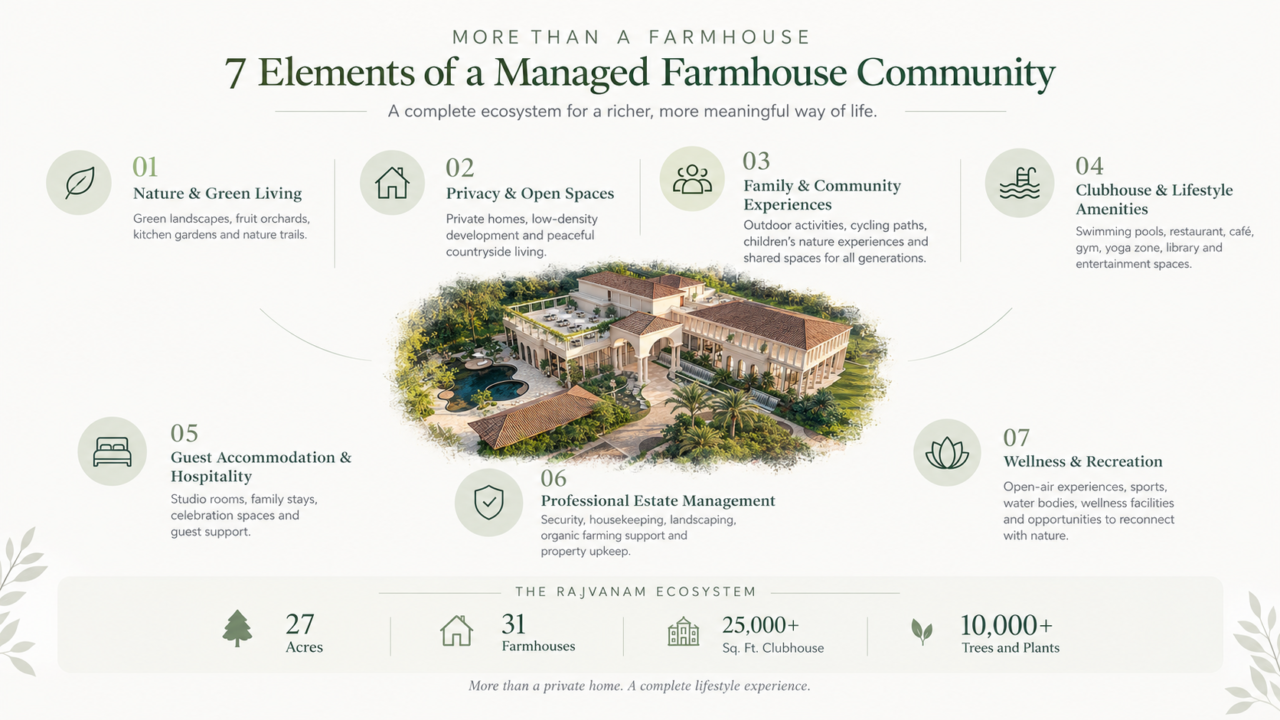
Rajvanam’s distinctiveness does not come from one individual feature. It comes from how each part of the estate connects to the next.
| Part of the ecosystem | How it contributes to everyday living |
| Private homes, gardens and kitchen gardens | Gives families privacy, space and a connection with the land |
| Orchards, trails, music garden, and water bodies | Encourages time outdoors and creates a relaxed weekend rhythm |
| Clubhouse, café and dining | Makes gathering, dining and unwinding easy |
| Temple, wellness, pools and sports | Creates space for spirituality, movement, recreation and recovery |
| Children’s Nature Haven, hurdle zone, and open-air theatre | Gives younger family members meaningful outdoor experiences |
| Studio rooms and celebration spaces | Makes hosting family, friends and special occasions more comfortable |
| Estate management and security | Keeps the property ready and protected when owners are away |
| Regional connectivity | Adds access to wildlife, heritage and leisure experiences beyond the estate |
This is a more complete model of second-home ownership. The private farmhouse is central, but it is supported by a wider environment designed for family life.
Why the ecosystem matters for modern buyers
Buyers of luxury second homes near Delhi NCR increasingly expect one property to serve several needs. It may be a personal retreat, a place to host family, a setting for wellness, an occasional work base, or a home to enjoy across generations.
A complete estate ecosystem supports these needs through four types of value:
- Lifestyle value – More time outdoors, more relaxed weekends and a stronger connection with nature.
- Family value – A setting where children, parents and grandparents can enjoy the same place in different ways.
- Operational value – Professional care that reduces the burden of maintaining a large property from a distance.
- Long-term value – A low-density, well-maintained environment that remains relevant as expectations change.
Rajvanam also offers a managed homestay and eco-tourism programme for owners who choose to participate. This creates an additional use case for the property, supported by an on-ground team that handles guest bookings and upkeep. Any income depends on demand, owner participation, and operating performance.
More than a private home
The aspiration behind countryside ownership is changing. Families do not only want distance from the city. They want more quality within the time they spend away from it. A private estate offers space, and an ecosystem gives purpose to that space.
At Rajvanam, nature, hospitality, shared experiences, family recreation, guest stays and professional management are designed to work together. The result is a setting that feels personal without feeling isolated, luxurious without feeling excessive and natural without sacrificing comfort.
The lasting appeal of managed farmhouse living lies in this balance: a home that belongs to the family, within an environment that makes every visit easier, healthier and more rewarding.
Frequently Asked Questions
What makes a farmhouse estate eco-conscious?
A nature-led estate protects green cover, uses orchards and kitchen gardens meaningfully, supports outdoor living and plans the landscape as part of everyday life.
How does a curated community preserve privacy?
A low-density layout keeps homes and private gardens isolated, while shared facilities remain available for owners when they choose to use them.
What makes Rajvanam different from a conventional farmhouse project?
Rajvanam combines private estates with extensive green cover, organic farming, water bodies, hospitality, studio rooms, family recreation, a central clubhouse and professional estate management within one planned community.