
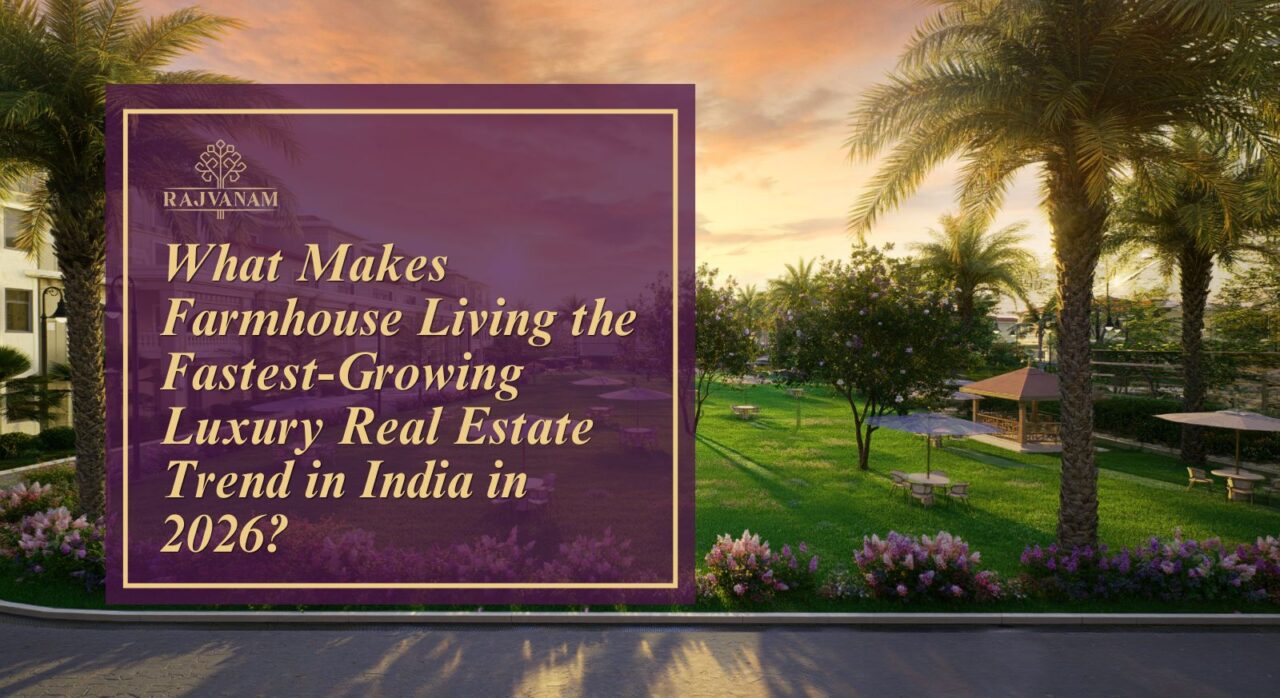
The definition of luxury living in India is undergoing a quiet transformation. While penthouses in metropolitan skylines and villas within gated enclaves continue to hold appeal, an increasing number of affluent families are seeking something that cities can no longer offer with ease: space, privacy, clean air, and a deeper connection with nature.
Farmhouse living in India in 2026 is not a passing trend. It reflects a deeper structural shift driven by changing lifestyle priorities, rising wealth creation and a growing preference for investments that deliver both financial and personal returns. It is a structural shift shaped by evolving lifestyle values, expanding wealth creation and a growing demand for assets that combine long-term appreciation with everyday quality of life.
In 2026, India’s real estate sector is poised for a new era, as land-based second homes and managed farmhouse communities have emerged as preferred choices for the affluent populace, providing privacy, space, and sustained value. This is precisely where the luxury farmhouse movement in India is gathering momentum.
Did You Know? 46% of wealthy second-home buyers in India chose farmhouses near city peripheries over urban luxury properties. (Survey done by India Sotheby’s International Realty, reported by Business Standard, May 2024).
Why Luxury Buyers Are Looking Beyond Conventional Urban Real Estate?
Over the last 20 years, luxury real estate in India has been synonymous with higher floors, taller buildings, and premium addresses, and that is no longer true.
Today’s affluent buyer seeks something more meaningful. Comfort, flexibility, wellness, community, and quality of life are increasingly reshaping purchasing decisions across India’s luxury housing market.
The air quality in Delhi NCR, the traffic chaos in Bengaluru, and the density in Mumbai have moved from being a nuisance to a serious health issue. It is becoming more popular to have amenities that promote health and wellness, including access to parks, walking paths, fitness centers, cycle tracks, and community gardens, that reconnect people to nature and with a harmonious lifestyle.
The question for the city dweller who already owns a home in the town center is not whether they would like to purchase a farmhouse, but rather where and how.
The 6 Forces Powering Farmhouse Living in India 2026
India’s affluent are turning away from vertical living, favouring land-based second homes and managed farmhouse communities. In fact, farmhouses, villas, and bunglows are expected to expand at a CAGR of 11.20% by 2031 redefining the luxury real estate market.
Listed and discussed the six powerful forces that are reshaping the country’s luxury real estate landscape from the ground up.
1. Wellness Is No Longer An Amenity
The luxury of holding a premium farmhouse lifestyle is no longer viewed as an indulgence. Increasingly, it is being recognised as a conscious investment in wellness, privacy and long-term quality of life.
The value of the Wellness Real Estate Market in 2024 was USD 463.24 billion and will grow to USD 944.11 billion by 2030 at a CAGR of 12.60%. India is one such rapidly expanding market.
This shift is visible with buyers actively seeking organic kitchen gardens, open landscapes, clean air, and low-density living. These amenities are no longer viewed as lifestyle extras. They have become the core brief. Managed farmhouse communities are uniquely positioned to deliver these at a scale and quality that urban developments structurally cannot.
2. Rising Wealth Is Reshaping Lifestyle Aspirations
India boasts more than 850,000 HNIs, which is expected to double to over 1.65 million by 2027. UHNWIs, in India, are projected to expand at double the global rate of 30%, rising 50% by 2028.
This expanding wealth is no longer being directed solely towards traditional assets. Increasingly, affluent buyers are seeking investments that combine capital appreciation, lifestyle value and long-term legacy potential. Farmhouse living in India 2026 is exactly at that point, and farmhouse real estate growth is the direct impact of the market.
3. Infrastructure Is Redrawing The Map of Indian Real Estate
In each cycle of the Indian real estate boom, it has been infrastructure that has led the way. The Yamuna Expressway did it for Noida. The Delhi-Mumbai Expressway is doing this for the outskirts of the NCR. Beyond this, the broader NCR connectivity story is also evolving rapidly.
Recent progress on the proposed Delhi-Mumbai Industrial Corridor (DMIC) and Delhi–Gurugram-SNB–Alwar Namo Bharat (RRTS) corridor is expected to strengthen long-term connectivity between Delhi, Gurgaon and the Alwar region, further enhancing the strategic importance of locations along this belt.
The Expressway Effect: According to ANAROCK, luxury housing prices in Delhi-NCR rose 72 percent between 2022 and 2025, the steepest rise among all major Indian cities.
Simultaneously, infrastructure upgrades across eastern Rajasthan, including proposed enhancements to the Alwar–Bharatpur corridor, are expected to improve regional accessibility and support long-term real estate growth in the broader region.
The demand for plotted developments, gated-community villas and vacation homes in unique locations will continue to be robust, as purchasers look to the space, wellness and experiential aspects of their homes. Historically, infrastructure corridors have been among the strongest indicators of future real estate appreciation, making such locations particularly relevant for long-term investors.
4. Professionally Managed Ownership Has Removed Traditional Barriers
Many HNIs have not been able to make it to farmhouse ownership in the past because it wasn’t about their desire; it was because of friction. Large properties were not a haven for the owner but a burden with a number of caretakers, remote security and constant monitoring.
Through a managed farmhouse model ownership becomes effortless by eliminating:
- Constantly monitored security and a gated entrance.
- Housekeeping and property maintenance services
- Landscape and organic agriculture are supported.
- NEC ensures that all rental and asset management needs are coordinated.
The owner comes to a property which is always ready, always maintained, and always adding value. That’s why Farmhouse Living India 2026 has moved beyond the realm of aspiration to mainstream HNI action.
5. Three Return Streams From a Single Asset
A well-positioned managed farmhouse can create value through three distinct channels simultaneously:
- Growth in the capital value due to the scarcity of land and the development of infrastructure.
- Lifestyle value through private family retreats, celebrations, wellness escapes and weekend living.
- Hospitality-led rental income through professionally managed short-stay programs.
6. A Tangible Asset with Legacy Value
Urban apartment yields continue to compress, while public markets remain inherently cyclical. Lifestyle inflation doesn’t necessarily match fixed income at substantial wealth amounts.
A Farmhouse living in India 2026 has legacy value, unlike any financial instrument that could be thought of by HNI families who are thinking beyond themselves. It becomes a place where wealth, memory and legacy converge, but at the same time, it’s a sound investment in capital.
What Serious HNI Buyers Evaluate Before Investing
| Evaluation Criterion | Why It Matters |
| Connectivity | Expressway and rail access support both convenience and future value |
| Environmental Quality | Low industrial activity preserves air quality and long-term desirability |
| Professional Management | Ensures effortless ownership and asset upkeep |
| Legal Transparency | Reduces investment risk |
| Lifestyle Ecosystem | Nature, culture and recreation enhance long-term appeal |
| Developer Credibility | Determines execution quality and operational excellence |
Why Rajvanam Is the Right Choice for India’s HNI Buyers in 2026
Rajvanam is purpose-built for India’s discerning HNI buyers who have outgrown the high-rise and are seeking land, privacy, and a slower, more intentional way of living. Since 2014, India’s Ministry of Road Transport and Highways (MoRTH) has overseen one of the most ambitious infrastructure expansions in the world, with the national highway network growing from 91,287 km to over 1,46,000 km showing a 60% increase in a decade. The crown jewel of this push is the Delhi–Mumbai Expressway, connecting the nation’s political capital to its financial capital across six states.
Rajvanam sits directly on this corridor in Govindgarh, just 90 minutes from Gurgaon and Jaipur within the DMIC’s Investment Region. The estate offers 31 luxury farmhouses across 27 acres, over 50% green cover, a 25,000+ sq. ft. clubhouse, and a fully managed ownership model that removes every operational burden from the buyer.
This is what land appreciation looks like before it happens with infrastructure arriving ahead of price, and a lifestyle that arrives right on time.
Conclusion
The rise of managed farmhouse communities reflects a broader shift in how affluent Indians define luxury. Increasingly, value is measured not merely by location or square footage but by the quality of life an asset enables.
As urban centres become denser and wellness assumes greater importance, land-based, professionally managed estates are emerging as a compelling intersection of lifestyle, legacy and long-term wealth creation.
For families seeking a place that can be enjoyed today, appreciated tomorrow and passed on to future generations, farmhouse ownership represents far more than a real estate decision. It represents a different way of living.
Among the emerging communities in this corridor, Rajvanam represents a thoughtful expression of nature-led luxury. This thoughtful infrastructural development project combines expansive private estates, orchards, water bodies, curated wellness amenities and professional management within a low-density, resort-inspired environment.
Designed around the principles of nature, luxury and royalty, it offers a contemporary interpretation of countryside living for discerning buyers.
Land is finite. Communities like this don’t stay open long.
FAQs
Q1. Why are HNIs choosing farmhouses over luxury apartments?
The definition of luxury has shifted. Clean air, open land, and privacy are no longer lifestyle extras but they are the brief. A generation that built wealth in cities is now investing in what cities cannot offer. Managed farmhouse communities have made that transition seamless and practical.
Q2. Is farmhouse living a lifestyle choice or a financial investment?
Yes, it is both. Villas and land-based properties are the fastest-growing segment within India’s luxury real estate market through 2031. Land along emerging expressway corridors has historically delivered strong appreciation, with infrastructure still arriving ahead of peak pricing. For HNI buyers, the entry window is now.
Q3. What has changed in 2026 to make this the right time?
Majorly three things:
1. Expressways have opened corridors that were previously too distant.
2. Managed farmhouse communities have professionalised the category.
3. India’s UHNWI population is actively seeking assets that deliver lifestyle, legacy, and capital appreciation together.
Q4. What should a buyer look for in a managed farmhouse community?
A buyer should look for –
1. Location on a verified infrastructure corridor.
2. Low density for lasting exclusivity.
3. Credible end-to-end management model.
4. Genuine natural environment like green cover, clean air, and water bodies.